Some writing on glssnt’s emergence in 2023
glssnt takes its name from the French poet and philosopher Édouard Glissant, who wrote in 1969: “To live the landscape with passion. To bring it out of the indistinct, to search it, to light it up among ourselves.” He was describing the natural world of contrasts native to his homeland Martinique, but I think the same logic can be applied to a city.
Here, the effects of global industrialisation have left some of us with a fractured playground of juxtapositions: wild flowers laugh into stones caging growth against a canal overgrown with license plates, lime bikes, and algae.
I grew up with these fragments. glssnt — a jewellery project which gives urban waste an afterlife as jewellery — became my way of relating to this landscape.
(I am a child and product of late-stage capitalism: becoming a brand was inevitable).
I thought of jewellery as a time-based medium best placed to frame this relationship. It is a form of carrying time on the skin — of physically tuning into the raw materiality which underpins the environment we live in — and of holding it, over long periods. Music can hold us together in a room, for a whole week, but after the fact, when the after party simmers, what happens to the recording as you listen in, again and again, washing the dishes? How does it wear you? Jewellery entreats: that relationship can be gifted — must be shared — a sense of how you presented yourself as the listener to a particular moment in time — is special too. Passed down like accoutrements to a record from generation to generation. Now you understand why I wear LPs as a scrunchie.
A gift is really how it started. I was secretly reading the prologue to Isolarii’s Archipelago Conversations between Hans Ulrich Obrist and Edouard Glissant (I’d bought it for a very close friend, but, ever devoted yet tragically under-read , I read the whole thing once over without bending the spine). I saw a shard of reflector on the pavement as I did. It incited a perfect link between Glissant’s words (“to light it up among ourselves”) and a ruby I could afford/get on board with, so much so, that I stopped to pick it up on my way to the station.
How do you inspire a value system to become a memory?
Via an accident of crossed wires: where the sea becomes city, with glass spilling out its shores incandescently.
I’d been studying Freud and Breton as part of Alyce Mahon’s course ’The Politics and Poetics of Surrealism’, and we’d touched on this idea that you could induce fear in a unconscious system (violence can be unconscious if inattentiveness is fixed to an acceptance of passive consumption) through a compulsive beauty (EAT IT, HAVE SEX WITH ME), destabilising what was imagined, and real. The automatic grounding of imagination in reality can be fruitful. Or literally: run the real aground in other associations until someone else picks up on its falsity.
(Also, imagine having a memory.)
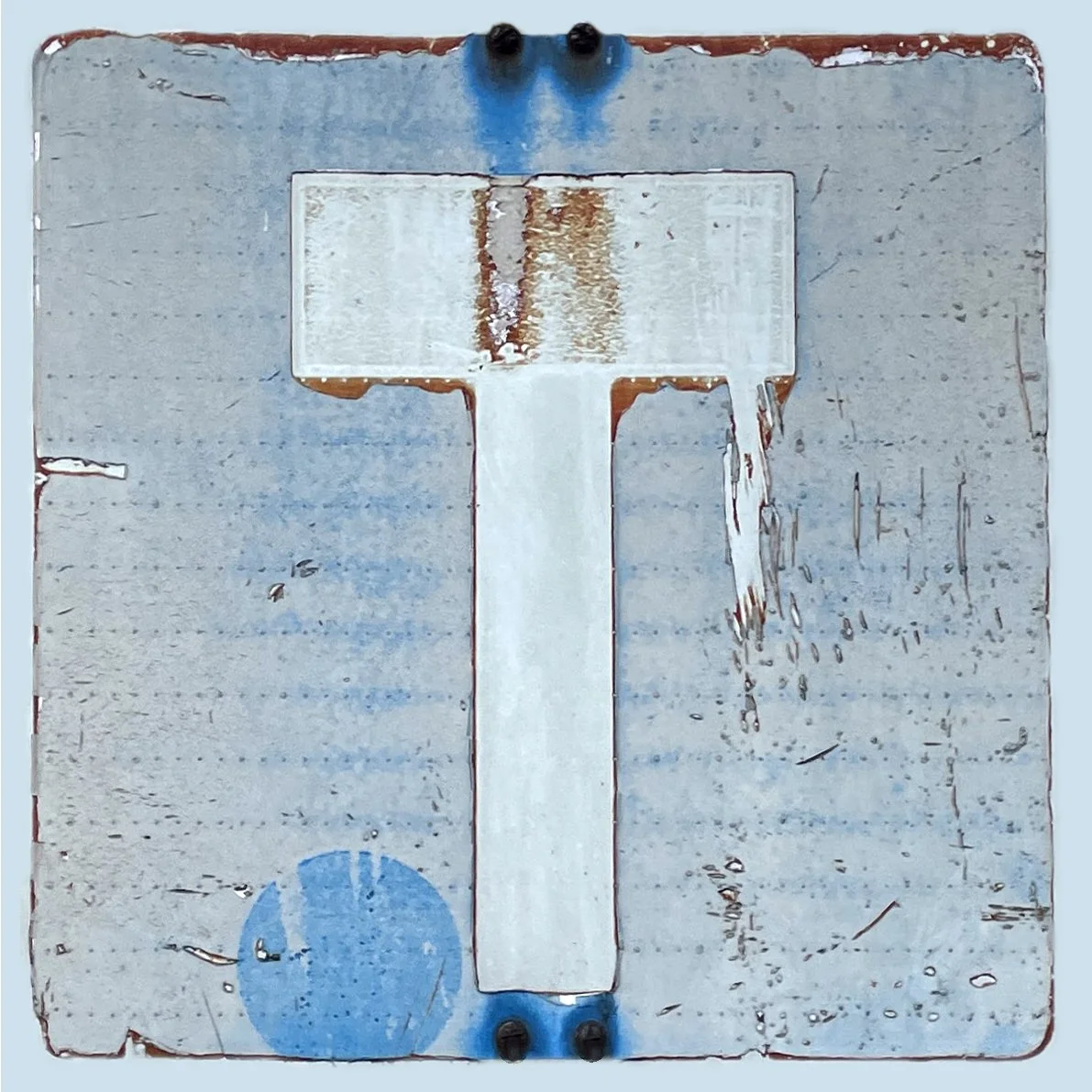
I wanted to live with the daily reminder to notice good quality engineering. Bike reflectors are a prime example of retroflection: an elegant solution to the need for light without electricity.
I looked to Hinge to help me with this mission. It was 2022: the height of dating app barter economies: I found a BAJ student who might trade his silversmithing skills in exchange for a good ol’ time (unfortunately for him, I’m a Capricorn venus), a rustic-grade quiche, and a fairly good photoshop of him posing as King Kong for his upcoming party. We made a ring together and never saw each other again, and now I do this for a living. Life is rife with opportune entanglements.
The reflector — the source of my fascination and arguable gemstone of Amsterdam/London — was invented by three men who riffed off each other through the ages. Richard Hollins Murray, a Mancunian, patented the use of glass beads and reflective lenses on road signs and advertising in 1927, until Percy Shaw almost ran over a cat driving home late at night from a pub in Halifax in 1934. Cat’s eyes for motorways made him a lot of money until Anton Loibl, Hitler’s chauffeur, adapted it for bicycles by incorporating glass chips in 1936, marketing the invention to fund the SS Lebensborn eugenics program.
Imagine forgetting that context is forged off the back of cross-currents. These days, we need to remember that context even exists — it’s too easy to take your pick of what looks good, and drop the rest of it. Today, context is residue. To take the turn of events and our resultant everyday materials for granted, and this is what London demanded of me: try to swim, do more, four streams of income, wait for a calmer moment and plan a French exit to a town with consistent cycling infrastructure. There, I was met with a different cadence: flowers on handlebars and more tourists than pigeons. We go to such lengths to support a route that runs on a delicate sense of rushing to arrive, and striving to be seen, that we don’t see the details of attention spans leaving us. I think it comes with forgetting how to take the time. To sit with time doesn’t just mean to meditate. All to often, that happens out of context too. It means choosing to present yourself to a small thing in the chaos which has nothing to give to you (if it’s on the ground, it’s past use is either obsolete, or it’s fallen off a tree) because it exist as a byproduct of collisions, but time is money — and we all know that association is rigged— so what can we do?
That person’s bike under a tarpaulin in Willesden, and that lime bike repair van, making the rounds of Kentish Town station. The uber driver and his daughter, asking him why his eyes are closed at the dinner table. I wonder if more software is always the answer. Don’t you? The question of how to re-engage a painful memory which has nowhere to go, nowhere to live beyond shame. What does it do for these questions? I have to believe that we can do better to hold this, especially when the accident had nothing to do with us, but we live in it constantly. For more than a minute, I got a sense of what locality could mean, if we wanted it to.
(To the little girl skimming the shores in Barbados for blue and white sea glass in her panda black googles: nobody warned you; just keep swimming).
I’m fairly certain the idea stemmed from this root in a childhood memory. Mix in a curious fixation on Hot Wheels’ branding, which plays as a televised loop rent free in my head as I weave through the industrial (chic) borderlands to get to the studio: a route which many of you will know never involves less that 45 minutes on public transportation, and you have yourself a silver ring set with a red reflector ‘ruby.’
I thought about wearing this fragment — as a memory which wasn’t mine, but which I chose to value — as a way to wear this memory out: subconsciously. A subversion takes minutes, but taking the time to live this philosophy of un-learning apathy through plastic, a material contested for its misuse (cc: deliberate, for reasons of money) — will outlive us globally, taking its place in the crust of the Earth next to silver and diamonds. Realities like these need proposing to if we want to live honestly and not spin a lie of a circular economic Eden to our children.
I learnt stone setting on evening courses at City Lit, Morley College, Working Men’s College and the London Jewellery Workshop in order to collaborate with this material, so that it might enter our vocabulary of attention.
{Frame the source of the accident until the system learns to read.}
It led to combining reflectors with other fragile echoes of Things Which Fall Outside Our Systems of Care (cAn YoU fEeL iT?) because I realise more and more now that resources are scarce and archives are not shrinking, they’re growing — digitally. Materially, they’re indistinct, and this is the problem. All of this runs kingdom runs on matter, and I love that I bump into this realisation daily, cycling home past the parks or walking down my road on my way to the station. Don’t skew it, take them. Take these echoes with you as you leave, because subversion is sometimes the only thing we can get our hands on, and there is a reason we have ten fingers (note: not to scroll, to hold). I want to live in a big, more-than-human city where bio-integrated design is on the curriculum and the street-lights are bioluminescent, but for now, I’ll settle for plastic which glimmers.
To the young girl watching the red glow of the radio towers from her bedroom window on a remote farm in Issoudun, France, 1979, you wished so hard for those lights to hear your whys, and take you away to a place where your sensibility might be seen — thank you for passing this down to me. I am your daughter, and I will always carry us with me.
To conclude this note-stringing, I’ll stop moving cities when I start to describe my locality in intricate detail; as something to be proud of. I’ll adorn myself with it, and hope that this project will one day become obsolete because it finally served its purpose: as a gimmick, a bridge between their trash and our treasure: the bygones of a forgotten era of rampant consumerism and careless petrochemical industry.